




Jewellery Design Pattern Identification using AI


Challenge
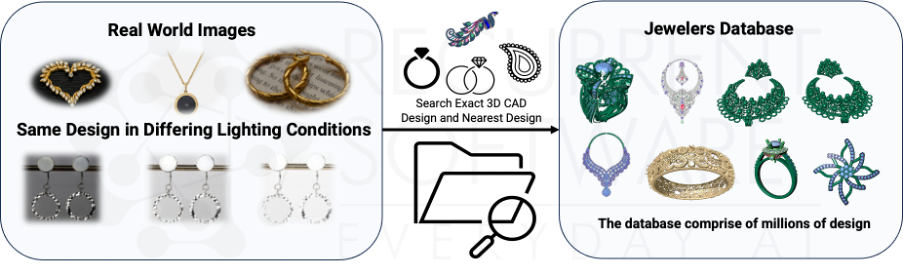
Leading Indian Jewellery Manufacturer faced challenge in searching for jewellery designs and identifying patterns in a database containing millions of designs and the process used was highly inefficient , time-consuming and majority of time inaccurate. It relies on manual comparisons, which slow down workflows, increase the risk of errors, and delay the time it takes for new designs to reach the market. This manual approach hampers productivity, making it difficult to manage inventory effectively and capitalize on design opportunities efficiently.

Solution
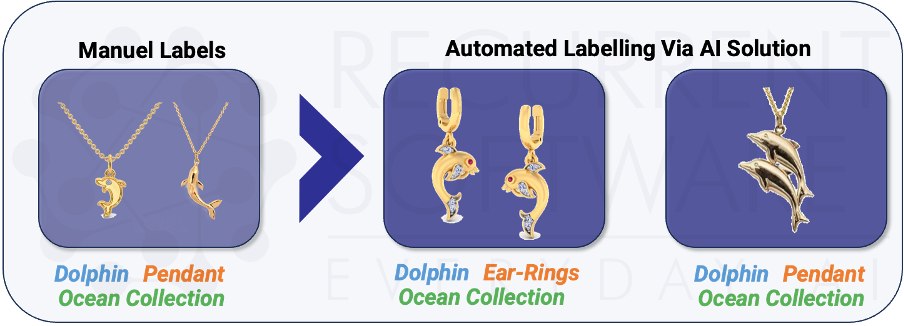
An AI-powered solution for comparing new jewellery designs with a database of existing ones would transform the design process. Using advanced image recognition and machine learning, it could quickly identify the most appropriate matches, reducing the time and effort needed for manual comparisons. This automation would improve inventory management, minimize redundant designs, and allow designers to focus on innovation, while also providing valuable insights into design trends.
Jewellery CAD Design Retrieval Using Image-Based Search and Existing Design Database
Auto Labeling: Utilize Existing Labels to Tag New Designs

Outcome
This approach lead to significant improvement in inventory management by enabling more efficient tracking and categorization of jewellery designs, reducing the occurrence of redundant or similar designs. As a result, manufacturers can streamline production processes, minimize wasted resources, and accelerate the time it takes for new designs to reach the market. Ultimately, this leads to faster decision-making, better alignment with market demand, and increased overall productivity, giving companies a competitive edge in a fast-paced industry.

Approach
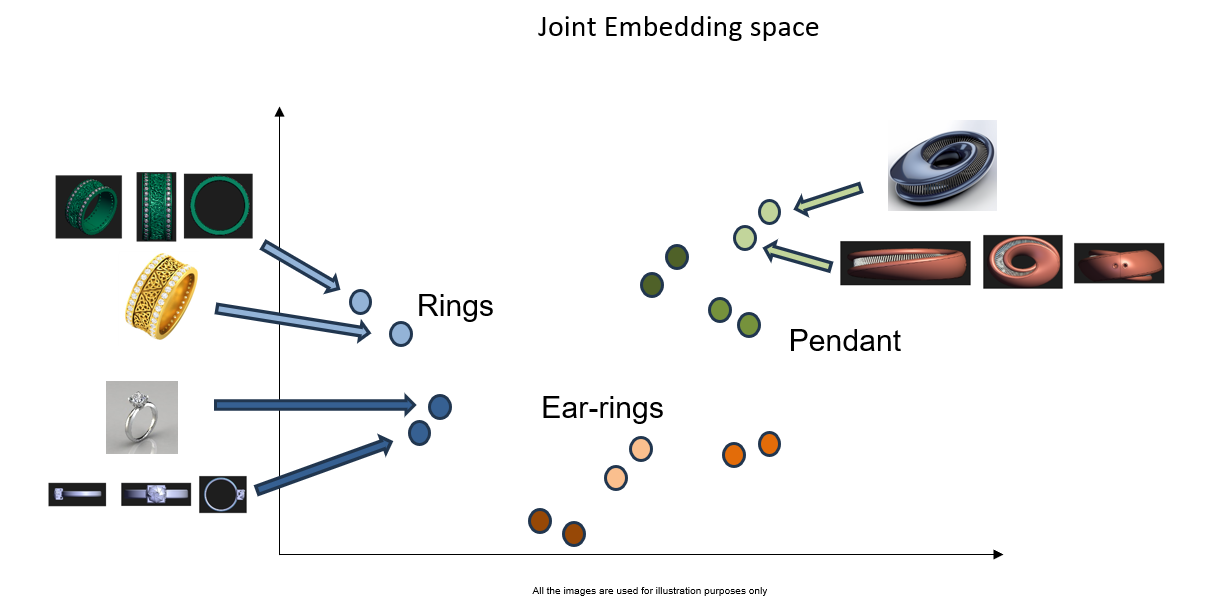
The core idea of the approach is to create a joint embedding space across 2D images, 3D CAD models, and text descriptions using deep learning. By representing all three modalities as embeddings in a unified vector space, we enable seamless cross-modal searches. This allows for efficient retrieval of designs based on nearest neighbor searches, significantly improving the accuracy and speed of the design retrieval and comparison processes.

Technology
Pre-trained Models:
Used pre-trained models for each modality: CNNs for 2D images, Multi-View CNNs for 3D CAD data, and CLIP for text representation.
Unified Embedding Space:
Self-supervised learning with contrastive loss (similar to CLIP) was used to optimize the deep learning model, along with pre-trained encoders using data triads—text, CAD, and image. This approach enabled the creation of a unified space for effective cross-modal searches.
Vector Search:
Used FAISS for storing and retrieving nearest neighbors based on Cosine similarity, ensuring efficient search across millions of data points.
Database Management:
MongoDB managed design metadata and provided efficient querying capabilities.
Cloud Infrastructure:
Azure provided scalable infrastructure, with Blob Storage for storage and GPU nodes are used for training and inference of Deep Learning models used.

Technical Landscape





Talk to our Expert
Connect with our experts for tailored AI solutions that drive innovation and efficiency. How can we help?

Let'sdiscuss a solutionfor you